Revit BIM Services for Prefab and Modular Construction: Streamlining Off-Site Manufacturing
The construction industry stands at a pivotal moment. With the global modular construction market projected to reach $208 billion by 2030, growing at a compound annual growth rate of 6-8%, the shift toward off-site manufacturing is no longer a trend—it's a transformation. At the heart of this revolution lies a powerful enabler: Revit BIM services.
As prefabrication and modular construction methods reshape how we build, the role of Building Information Modeling has evolved from a documentation tool to an essential orchestration platform that connects design intent with manufacturing precision. For architecture firms, contractors, and developers venturing into prefab and modular projects, understanding how professional Revit BIM services can streamline off-site manufacturing is critical to competitive advantage.
The Modular Construction Boom: Why Now?
The numbers tell a compelling story. Modular construction reduces build times by up to 50%, with projects averaging 8 months versus nearly 10 months for traditional stick-built construction. Cost savings range from 10-20%, with some projects achieving up to 30% reduction in overall expenses. Perhaps most significantly in today's sustainability-conscious market, modular construction generates 50% less waste than conventional methods.
But speed and cost aren't the only drivers. The construction industry faces acute labor shortages, with skilled trade positions remaining unfilled across major markets. Off-site manufacturing addresses this challenge by shifting work to controlled factory environments where efficiency gains of 30-50% in material usage are common. The U.S. modular construction market alone reached $20.3 billion in 2024, representing 5.1% of total construction activity in key segments.
For developers and contractors, the appeal is clear: predictable timelines, controlled quality, reduced weather delays, and the ability to overlap site preparation with module fabrication. Yet realizing these benefits hinges on one critical factor—precision in digital coordination before a single module enters production.
Why Revit BIM is Essential for Modular Success
From Design Intent to Fabrication Reality
Traditional construction tolerates a degree of ambiguity. Site-built projects can accommodate field adjustments, and experienced crews often interpret drawings based on conventional practice. Modular construction offers no such flexibility. When components are manufactured off-site, every dimension, connection point, and system integration must be precisely defined before fabrication begins.
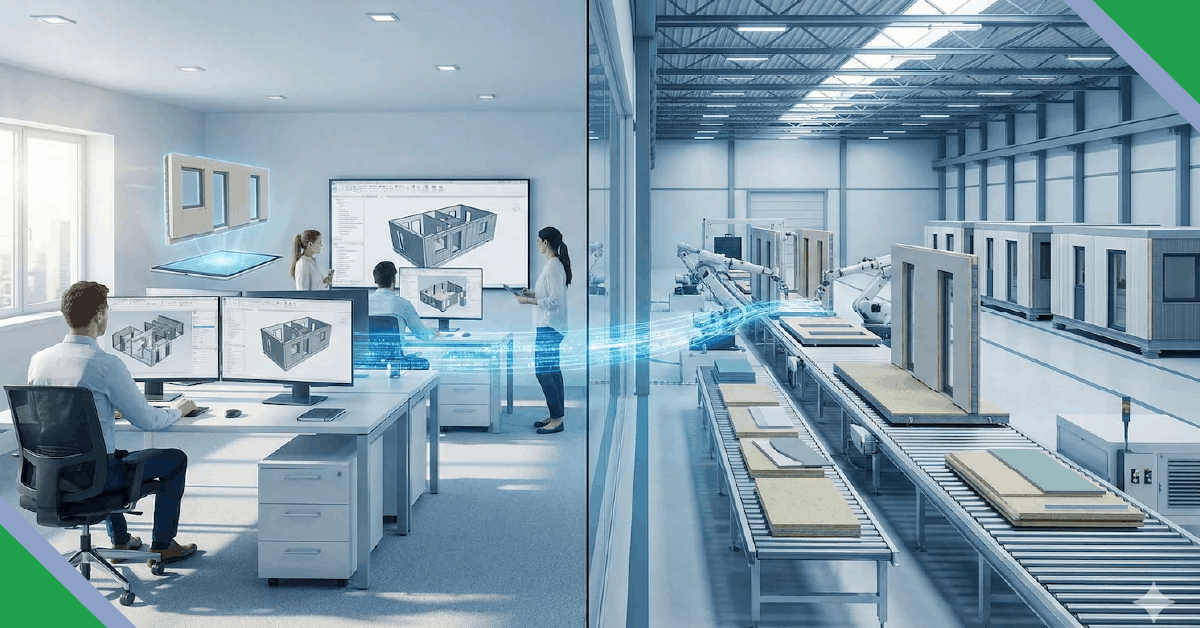
This is where Revit BIM services transform the workflow. Unlike 2D CAD drawings that require interpretation, a fully coordinated Revit model serves as a single source of truth—a digital prototype where conflicts are resolved, tolerances are verified, and fabrication data is embedded directly into the model elements.
The Coordination Imperative
One of the most documented success stories in modular BIM coordination involved a healthcare project where the team achieved $350,000 in cost savings, a nine-week schedule reduction, and a 30% decrease in safety incidents—all attributed to comprehensive Revit coordination before fabrication. The alternative scenario, where coordination issues surface during installation, can devastate project economics and timelines.
Professional Revit BIM services address three critical coordination challenges in modular construction:
- Multi-discipline clash detection: MEP systems must route through structural modules without conflicts. In traditional construction, minor clashes might be resolved on-site. In modular work, a duct conflicting with a beam isn't discovered during installation—it's discovered when a pre-fabricated module doesn't fit. Advanced clash detection in Revit identifies these conflicts before manufacturing.
- Tolerance management: Modular units typically maintain tolerances within 1/8 inch, far tighter than site-built construction. Revit's parametric modeling ensures that these tolerances are maintained throughout the design, and any deviations trigger immediate flags for resolution.
- Connection point precision: Where modules connect—whether to each other, to site-built elements, or to MEP risers—the interface must be exact. Revit BIM services create detailed connection models that guide both factory fabrication and field assembly.
How Revit BIM Services Streamline Off-Site Manufacturing
1. Design for Manufacturability (DfM) Integration
The most successful modular projects begin with manufacturing constraints built into the design phase. Professional Revit BIM services incorporate DfM principles from concept through construction documents:
- Modular coordination grids: Rather than arbitrary dimensions, Revit models are structured around manufacturing modules. This might mean 12-foot modules for hotel bathroom pods or 60-foot modules for multi-family residential units. The parametric nature of Revit allows designers to establish these grids early and maintain them throughout design development.
- Repetition and standardization: Modular construction economics rely on repetition. Revit family creation services enable teams to develop standardized components—bathroom pods, mechanical rooms, wall panels—that can be replicated across projects. These families carry not just geometry but embedded fabrication data: material specifications, connection details, and installation sequences.
- Transportation and handling constraints: A module that can't be transported is useless. Professional Revit services model not just the building but the delivery logistics—ensuring modules fit within road transport limits (typically 16 feet wide, 70 feet long) and include appropriate rigging points for crane operations.
2. Automated Fabrication Documentation
One of the most time-consuming aspects of modular projects is generating the shop drawings and fabrication documents required by manufacturers. Here, Revit BIM services deliver enormous value:
- Automated shop drawing generation: From a coordinated Revit model, specialized services can extract module-specific fabrication drawings showing exact dimensions, material call-outs, and assembly sequences. These aren't generic construction documents—they're factory work instructions.
- Bill of Materials (BOM) extraction: Every component in a Revit model can carry cost, supplier, and specification data. For modular manufacturers, this means automated material ordering that's synchronized with production schedules. When design changes occur, BOMs update automatically.
- Barcode and RFID integration: Leading modular manufacturers use digital tracking throughout fabrication. Revit models can generate unique identifiers for each module and component, supporting automated tracking from factory floor to final installation.
3. MEP Prefabrication Optimization
Mechanical, Electrical, and Plumbing systems represent the highest coordination complexity in modular construction. The confined spaces within modules—particularly in bathroom pods, mechanical rooms, and interstitial spaces—demand precise MEP routing. Revit MEP drafting services address this through:
- 3D MEP routing and clash detection: Every pipe, duct, conduit, and cable tray is modeled in 3D space. Automated clash detection identifies interferences not just between disciplines but between MEP systems and structural components, architectural finishes, and even future maintenance access requirements.
- Prefabrication-ready MEP assemblies: Rather than routing individual pipes, experienced Revit MEP services create prefabricated assemblies—skids, racks, and panels that can be manufactured as units and installed in modules. This reduces field labor by up to 60% compared to stick-built MEP installation.
- Performance analysis integration: Modern Revit MEP workflows integrate energy modeling and system performance analysis. For modular projects targeting high energy efficiency, this means validating HVAC performance, pressure drops, and load calculations before fabrication.
4. Quality Control and As-Built Documentation
Off-site manufacturing environments implement stringent quality control, and Revit models support this at every stage:
- Digital inspection protocols: The Revit model becomes a checklist. As modules progress through fabrication, inspectors verify that as-built conditions match the model. Deviations are documented directly in the model, creating a living record.
- Facility management handover: Unlike traditional construction where as-built documentation often lags months behind completion, modular projects with robust Revit BIM services can deliver as-built models immediately upon installation. This includes embedded equipment data, warranty information, and maintenance schedules.
Real-World Applications: Where Revit BIM Makes the Difference
High-Rise Residential Modular
Multi-story modular buildings present unique challenges. A 193-unit residential building documented in industry research reduced its construction timeline from 24 months to 14 months through modular methods—a ten-month savings. The key enabler was comprehensive Revit coordination that allowed structural modules, MEP risers, and envelope panels to be fabricated simultaneously while site work progressed.
Healthcare Prefabrication
Hospital projects demand exacting MEP coordination due to medical gas systems, specialized HVAC requirements, and infection control. Modular bathroom and headwall assemblies, coordinated through Revit BIM services, have become standard in acute care construction. The Stavanger University Hospital project in Norway utilized Revit as a collaborative BIM platform from early design, implementing cross-discipline modular workflows for a 100,000 square meter facility.
Industrial and Data Center Modules
Where repetition is highest, modular ROI peaks. Data centers increasingly use prefabricated mechanical modules, electrical gear rooms, and even server halls. These projects leverage Revit family creation to develop standardized, tested assemblies that can be replicated across multiple facilities, reducing both design time and manufacturing cost.
Implementing Revit BIM Services for Your Modular Project
When to Engage BIM Services
The earlier, the better. Industry experience shows that modular projects achieve optimal results when BIM coordination begins during conceptual design. At this stage, fundamental decisions about module sizing, shipping constraints, and connection strategies are still flexible. Waiting until construction documents are complete—as happened in some early modular projects—severely limits the ability to optimize for manufacturing.
What to Expect from Professional Services
When engaging Revit BIM services for modular construction, expect deliverables beyond standard architectural documentation:
- LOD 400 coordinated models: Level of Development 400 represents fabrication-level detail. Every component is modeled with sufficient precision for direct manufacture.
- Federated model coordination: Separate discipline models (architecture, structure, MEP) linked and coordinated in a federated environment using IFC standards or native Revit linking.
- 4D construction sequencing: Integration with scheduling tools (Navisworks, Synchro) to visualize module fabrication sequences and installation logistics.
- Manufacturer collaboration protocols: Direct engagement between BIM teams and fabrication partners to ensure model data translates accurately to CNC equipment, cutting lists, and assembly jigs.
Choosing the Right BIM Partner
Not all Revit services are created equal for modular work. Look for providers with:
- Manufacturing experience: Understanding how factories operate—production line constraints, material staging, just-in-time delivery—shapes how models are structured.
- MEP prefabrication expertise: Deep knowledge of prefabricated MEP assemblies, routing optimization, and system performance validation.
- Proven coordination workflows: Demonstrated experience with clash detection protocols, issue tracking systems, and multi-party collaboration platforms.
- Parametric modeling capabilities: For projects with significant repetition, advanced Revit family creation and Dynamo scripting can automate design variations and accelerate documentation.
The Business Case: Quantifying BIM Value in Modular Projects
Investment in professional Revit BIM services for modular construction typically represents 1-2% of total project cost. The returns, however, are substantial:
- Reduced RFIs and change orders: Comprehensive coordination before fabrication dramatically reduces requests for information and field changes. Industry data shows 40-60% reduction in RFIs on well-coordinated modular projects.
- Accelerated project delivery: The parallel workflow—where site work and module fabrication occur simultaneously—compresses schedules. Time savings of 30-50% are common, translating directly to reduced financing costs and earlier revenue realization.
- Lower labor costs: Shifting work from high-cost field labor to factory environments with productivity gains yields significant savings. Combined with reduced rework, labor cost reductions of 20-30% are achievable.
- Quality improvement and warranty reduction: Factory-controlled conditions produce more consistent quality. Warranty claims on modular projects with robust BIM coordination run 40-50% lower than equivalent site-built work.
For a typical $20 million modular project, these factors can combine to deliver $2-4 million in total savings and value creation—an ROI of 100-200x on BIM service investment.
Common Challenges and How to Overcome Them
Challenge 1: Late Design Changes
The Problem: Client changes after fabrication begins are catastrophic in modular construction. Unlike site-built work where some field modifications are possible, changing a module in production can require complete re-manufacture.
The Solution: Front-load decision making. Use Revit visualization capabilities—renderings, virtual reality walkthroughs, animated construction sequences—to secure stakeholder buy-in early. Implement formal model approval milestones before fabrication release.
Challenge 2: Manufacturer Integration Gaps
The Problem: Some modular manufacturers work from traditional 2D drawings and resist BIM workflows, creating a translation gap between design intent and fabrication.
The Solution: Engage manufacturers during design. Many progressive fabricators now accept native Revit models or IFC exports. For those who don't, comprehensive shop drawing extraction from the Revit model ensures fabrication documents are derived directly from the coordinated 3D model.
Challenge 3: Transportation and Logistics Oversights
The Problem: A perfectly designed module that can't be transported to site or maneuvered into position represents a spectacular failure.
The Solution: Model the logistics. Include transport envelope checks, crane radius studies, and installation sequence simulations in the BIM workflow. Some advanced Revit services use custom families that represent transport trucks and cranes to validate clearances.
The Future: Where BIM and Modular Construction Are Headed
The intersection of Revit BIM services and modular construction continues to evolve rapidly:
- AI-driven optimization: Emerging tools use artificial intelligence to analyze Revit models and suggest optimal module configurations, MEP routing, and material specifications based on manufacturing constraints and cost parameters.
- Digital twin integration: The Revit model increasingly extends beyond construction into operations. IoT sensors in modules feed data back to the digital model, creating a living digital twin for facility management.
- Direct CNC integration: Progressive manufacturers are moving toward direct model-to-machine workflows where Revit family geometry drives CNC cutters, robotic welders, and automated assembly equipment with minimal human translation.
- Blockchain and smart contracts: Some projects now link BIM model milestones to automated payment systems, where completion verification triggers contract payments through blockchain protocols.
Conclusion: BIM as Manufacturing Enabler
The transformation of construction from a largely site-based craft to an increasingly manufacturing-oriented industry is well underway. With the global modular construction market growing at 6-8% annually, the question for architecture firms, developers, and contractors is not whether to adopt modular methods, but how to do so successfully.
The answer lies in recognizing that modular construction is fundamentally a manufacturing process that happens to produce buildings. And like all manufacturing, it depends on precision, coordination, and data-rich documentation. This is where professional Revit BIM services move from optional enhancement to critical infrastructure.
For firms embarking on their first modular projects, investing in experienced BIM coordination pays immediate dividends in avoided conflicts, accelerated schedules, and reduced costs. For those already engaged in prefabrication, advancing BIM capabilities—through LOD 400 modeling, automated fabrication documentation, and manufacturer integration—unlocks the next level of competitive advantage.
The construction industry's future is increasingly manufactured. Those who master the digital tools that enable that future will lead the transformation.
Ready to Streamline Your Modular Construction Projects?
At DigitiseIT, we specialize in Revit BIM services tailored for prefabrication and modular construction. With over two decades of experience serving global clients, our team understands the unique demands of off-site manufacturing—from LOD 400 coordination models to automated fabrication documentation.
Whether you're planning your first modular project or looking to optimize existing prefab workflows, our experts can help you leverage BIM for maximum efficiency and cost savings.
Contact us today to discuss how our Revit BIM services can transform your next modular construction project.