Renovation and retrofitting projects often begin with a major challenge: the lack of reliable as-built documentation. In many cases, original drawings are outdated, incomplete, or no longer reflect on-site conditions. Even small inaccuracies in measurements can lead to design clashes, construction delays, and costly rework.
This is where Matterport scan conversion plays a critical role. By transforming Matterport 3D scans into accurate CAD drawings or BIM models, project teams gain a reliable digital representation of existing conditions—forming a strong foundation for renovation and retrofit planning.
What Is Matterport Scan Conversion?
Matterport scan conversion is the process of converting Matterport 3D scan data into usable technical deliverables such as:
- 2D CAD floor plans
- Sections and elevations
- Reflected ceiling plans
- 3D BIM or as-built models
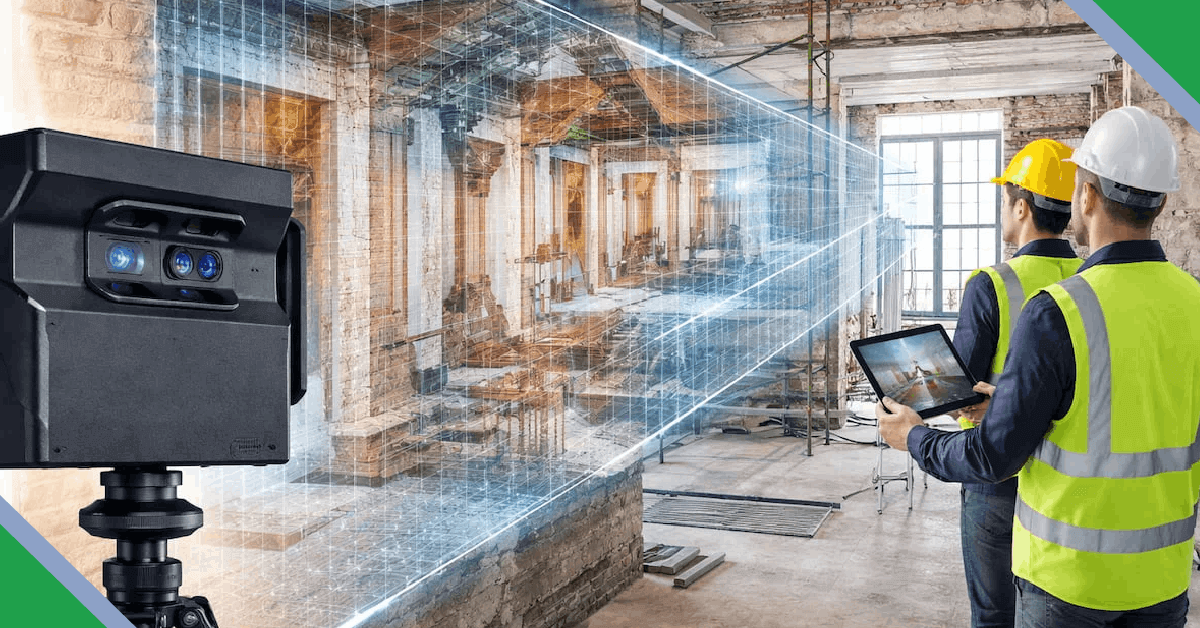
Matterport captures spatial data using a combination of depth sensors, imagery, and spatial mapping. When this data is professionally processed and converted, it results in true-to-scale documentation that accurately reflects the existing building conditions.
Why Accuracy Is Critical in Renovation & Retrofitting Projects
Unlike new construction, renovation projects must work within the constraints of existing structures. Accuracy is not optional—it is essential.
Hidden Site Conditions
Walls may not be plumb, floors may slope, and structural elements may differ from legacy drawings. Without accurate documentation, these deviations remain undiscovered until construction begins.
Cost of Rework
Incorrect measurements often result in:
- Design revisions
- Material wastage
- On-site modifications
- Schedule overruns
Coordination Between Trades
Mechanical, electrical, plumbing, and architectural teams rely on the same base drawings. Any error multiplies across disciplines.
Common Accuracy Issues with Traditional Site Measurement Methods
Manual Measurements
Tape or laser measurements are time-consuming, prone to human error, and difficult to use for capturing complex geometries.
Outdated Drawings
Existing drawings often do not reflect past modifications, miss concealed services, and rely on inconsistent reference points.
Limited Site Access
Occupied buildings, live plants, or restricted areas make full site measurement impractical.
How Matterport Scan Conversion Solves These Accuracy Challenges
- High-density spatial capture: Thousands of spatial data points provide comprehensive site coverage.
- True-to-scale geometry: Converted drawings maintain proportional accuracy.
- Reduced human error: Automated capture minimizes manual measurement risks.
- Single source of truth: A consistent reference for all project stakeholders.
Matterport to CAD vs Matterport to BIM: Which Is Better for Retrofit Projects?
Matterport to CAD Conversion
Best suited for:
- 2D renovation drawings
- Fit-out layouts
- Permit and approval documentation
- Budget-sensitive projects
Typical outputs include floor plans, sections, elevations, and reflected ceiling plans.
Matterport to BIM Conversion
Ideal for:
- Complex retrofitting projects
- MEP coordination
- Clash detection
- Long-term asset management
Typical outputs include as-built BIM models and coordinated discipline data.
Typical Deliverables from Matterport Scan Conversion
- Accurate as-built floor plans
- Sections and elevations
- Reflected ceiling plans
- Furniture and fixture layouts
- Structural reference drawings
- BIM models with defined LOD
Real-World Renovation Scenarios Where Matterport Conversion Adds Value
Office Renovation Projects
Accurate space documentation supports efficient layout redesign, service routing, and compliance planning.
Retail & Commercial Retrofits
Fast turnaround of as-built drawings enables quicker store rollouts and minimizes operational downtime.
Industrial & Plant Upgrades
Precise documentation supports equipment upgrades without disrupting ongoing operations.
Key Considerations Before Converting Matterport Scans
- Scan quality and coverage
- Required level of detail (LOD)
- Accuracy tolerances
- Final deliverable format (CAD or BIM)
How Matterport Scan Conversion Fits into a Renovation Workflow
- Site scanning using Matterport
- Processing and validation of scan data
- Conversion to CAD or BIM deliverables
- Design development using accurate as-builts
- Construction and retrofit execution
Conclusion
Accurate as-built documentation is the foundation of successful renovation and retrofitting projects. Matterport scan conversion provides a reliable, efficient, and scalable way to capture existing conditions and translate them into actionable design data.
By minimizing measurement errors, improving coordination, and supporting informed decision-making, Matterport-based conversions help renovation projects stay on schedule and within budget.
Frequently Asked Questions
Can Matterport scans be converted into CAD drawings?
Yes. Matterport scans can be converted into accurate 2D CAD drawings including floor plans, sections, and elevations.
How accurate are Matterport-based as-built drawings?
When properly captured and converted, Matterport-based drawings provide high spatial accuracy suitable for most renovation and retrofit projects.
Is Matterport suitable for retrofit documentation?
Yes. Matterport is particularly effective for retrofit projects where existing drawings are missing or unreliable.
Should I choose CAD or BIM for renovation projects?
CAD is suitable for straightforward renovations, while BIM is better for complex projects requiring multi-discipline coordination.